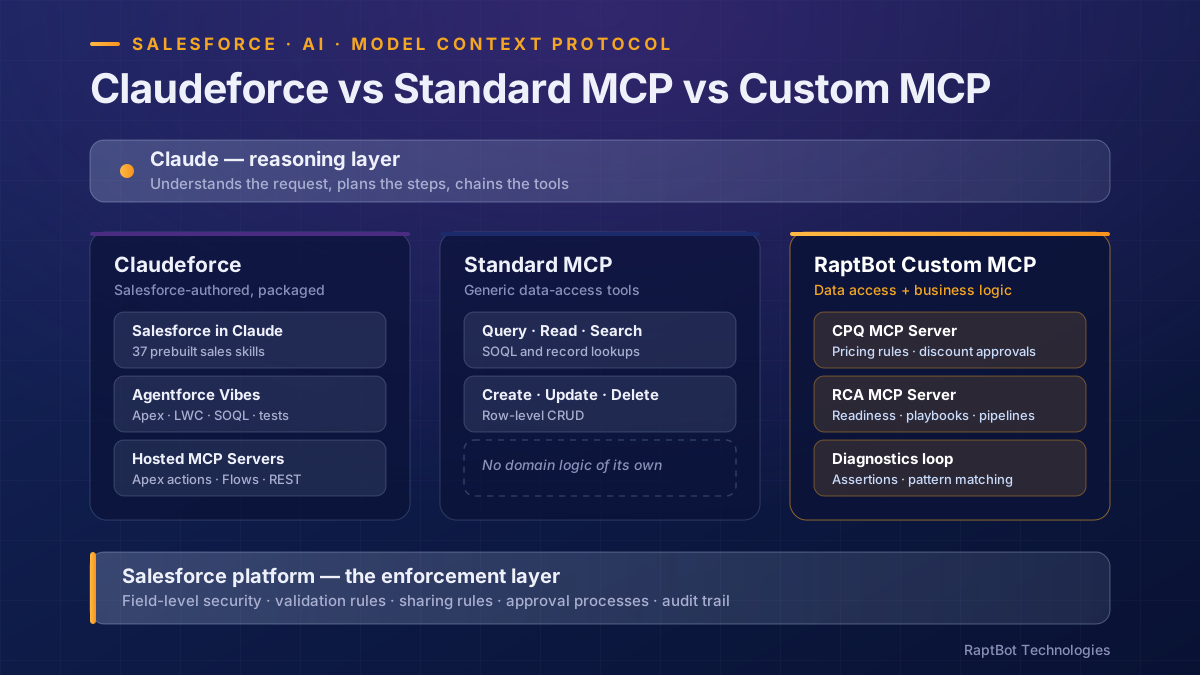
There are three ways to put Claude in front of Salesforce data today: Claudeforce, Salesforce's own packaged offering; a standard MCP server that exposes the platform's primitives; and a custom MCP server built around one org's business logic. All three run on the same foundation — Model Context Protocol (MCP) — and all three are governed by the permissions your org already enforces.
This post covers what Claudeforce ships today, how the MCP layer underneath it works, and how to tell which layer your problem belongs in. Short version: they stack rather than compete.
What is Claudeforce?
Claudeforce is the expanded Salesforce–Anthropic partnership announced on 26 August 2026. In Salesforce's own words, it exists "to put your trusted data to work inside Claude — governed by the permissions and business rules your company already runs on." Four strands are visible today:
- Salesforce in Claude — a plugin bringing 37 prebuilt sales skills into Claude, grounded in Salesforce's 27 years of CRM experience.
- Claude inside Agentforce — Claude as the reasoning model behind Salesforce's own agent products.
- Claude across Slack — including Claude Tag, an AI teammate for Slack, and Claude as a launch partner for Slack Code.
- A technology cross-licensing arrangement between the two companies.
The idea underneath is straightforward. Salesforce is opening up the CRM — customer records, pricing rules, approval logic — so Claude can read it, reason over it and act on it directly. Claude supplies the reasoning; the platform keeps enforcing the rules.
Checking current status: this space moves month to month. Salesforce's product page — salesforce.com/claudeforce — is the authoritative source for what has shipped and what is next. Everything factual here is checked against it as of early September 2026.
Two audiences, one foundation
What people call Claudeforce spans two product threads with different audiences. Worth separating before you plan around either.
| Product thread | Salesforce in Claude | Agentforce Vibes + Hosted MCP Servers |
|---|---|---|
| Built for | Sellers, sales and RevOps leaders | Salesforce developers and admins |
| What it does | Pipeline review, deal health, meeting prep, forecasting, CRM hygiene — 37 prebuilt skills | Writing and testing Apex and LWC, running SOQL, managing metadata, and exposing org logic as MCP tools |
| Status | With pilot customers; open beta planned September 2026 | Vibes is GA in Developer Edition, and available in paid orgs via a VS Code extension |
| Branding | Marketed under the Claudeforce name | Marketed as Agentforce Vibes — the same MCP foundation and the same Claude models, under its own label |
Salesforce has not published all 37 skill names; the capability groupings in this post are the ones named in launch materials — representative, not exhaustive.
How Claudeforce works
Three pieces do the work, and the middle one is the piece architects should look at hardest.
- Headless 360 — the harness. A collection of Salesforce capabilities that exposes org data, workflows and business rules to any agent through MCP servers, REST APIs and CLI tools rather than one-off point integrations. Listed as coming soon on Salesforce's product page.
- Hosted MCP Servers — the tool surface. Where MCP on Salesforce gets concrete: invocable Apex actions, autolaunched Flows, Apex REST endpoints,
@AuraEnabledmethods and Prompt Builder templates all become tools Claude can call. Note what that implies — your Apex and your Flows can become agent-callable, which is the door custom logic comes through. - Platform-enforced governance — the guardrail. Every action routes back through Salesforce, so field-level security, validation rules, sharing rules and approval processes are enforced by the platform rather than the model. Salesforce puts the permission model plainly: "Claude sees what the user is authorized to see, and can do what that user is authorized to do."
Two details for whoever signs this off: Salesforce advertises zero data retention on the Sonnet, Opus and Haiku models, and the two companies jointly built Enterprise Frontier Safeguards, a privacy and security layer rolling out in phases from autumn 2026.
The strategic point is bigger than the skill count: Salesforce is positioning the platform — data model, business rules, security, audit trail — as the trusted action layer every agent passes through, whether or not a human opens a screen. That sets the bar for any AI-plus-Salesforce approach, including ours: not "can the model do it," but "can you show what it was allowed to do."
How to start with Claudeforce today
- Salesforce in Claude (the plugin). It inherits the acting user's existing Salesforce permissions — a rep sees their deals, a manager sees the team. With pilot customers now and open beta planned for September 2026, this is the moment to try it on a real pipeline review.
- Agentforce Vibes (the IDE). Org-aware development: it reads real metadata and schema before generating Apex, LWCs, triggers and test classes, with a schema-aware SOQL Builder, a VS Code extension for paid orgs, and changes still flowing through DevOps Center. Free in Developer Edition, which makes it the easiest part of the ecosystem to trial this week.
- Hosted MCP Servers and the Salesforce DX MCP Server (the tool layer). The most interesting option for architects: over 20 built-in MCP tools, callable from Claude Code, Cursor or Windsurf rather than a single editor. Start here if you want to standardise on MCP across the stack.
Claudeforce vs standard MCP vs custom MCP
The three approaches differ less in what they can reach than in how much of your judgement is already encoded before the model starts reasoning.
- Claudeforce — Salesforce's packaged offering: prebuilt skills plus a first-party MCP layer, hosted by Salesforce and Anthropic. Strongest at standard sales work at volume, plus Apex, LWC and test generation on the developer side.
- Standard MCP — a general-purpose server exposing the platform's primitives: SOQL and SOSL, record reads and writes, describes, metadata operations. Salesforce's own DX MCP Server, a community server, or one you run in-house. Strongest at breadth: ad hoc reporting, lookups, bulk edits, exploratory queries.
- RaptBot Custom MCP — a server we build and maintain that wraps your actual Apex, Flows and process rules, so the model calls your business logic instead of inferring it. Strongest where correctness depends on rules outside the data model: quoting under real pricing governance, Revenue Cloud readiness, access lifecycle work.
All three use Claude as the reasoning layer, and all three read the same records through the same platform. Here they are side by side — tap any band heading to fold it away.
| Capability | Claudeforce | Standard MCP | RaptBot Custom MCP |
|---|---|---|---|
| Packaged and released by Salesforce | ✓Included | ◖Available with configuration | ○Left to another layer |
| No in-house engineering needed to stand it up | ✓Included | ◖Available with configuration | ✓Included |
| Usable in production today | ◖Available with configuration | ✓Included | ✓Included |
| Ships with prebuilt skills or playbooks | ✓Included | ○Left to another layer | ✓Included |
| Generic data access — SOQL, record CRUD, describes | ✓Included | ✓Included | ✓Included |
| Platform enforces FLS, validation, sharing and approvals | ✓Included | ✓Included | ✓Included |
| Open-ended questions nobody designed for in advance | ◖Available with configuration | ✓Included | ✓Included |
| Your Apex, Flows and approval logic callable as tools | ◖Available with configuration | ○Left to another layer | ✓Included |
| CPQ and Revenue Cloud operations with readiness checks | ◖Available with configuration | ○Left to another layer | ✓Included |
| Multi-step operations as one unit, with assertions and evidence | ○Left to another layer | ○Left to another layer | ✓Included |
| Past diagnoses stored as reusable patterns | ○Left to another layer | ○Left to another layer | ✓Included |
| Reaches data in systems beyond Salesforce | ◖Available with configuration | ◖Available with configuration | ✓Included |
| Extended on your own timeline | ◖Available with configuration | ✓Included | ✓Included |
| Runs alongside the other two in one Claude session | ✓Included | ✓Included | ✓Included |
Reading the marks: Claudeforce is built to behave the same way for every Salesforce customer, so an open ring in its column is scope rather than a shortcoming — and Hosted MCP Servers are the documented route to layering your own logic on top of it. On the partials: standard MCP is first-party through Salesforce's own DX MCP Server and needs deploying either way; Salesforce in Claude is in pilot ahead of open beta, while Claude Tag and Slack Code are available now and Revenue, Data 360, MuleSoft and Headless 360 are named as coming soon. Our CPQ, Revenue Cloud Advanced and lead-engine servers are running in client orgs, with each new one scoped per org. Status as of early September 2026 — on narrow screens, scroll sideways and the capability column stays pinned.
Where each layer leads
A standard MCP server hands Claude the raw primitives, which is exactly why it answers questions nobody anticipated when it was built: ask "which deals are at risk this week" and the model decides what "at risk" means, writes the query and assembles the judgement. Claudeforce trades some of that openness for consistency — its skills encode Salesforce's view of pipeline review, deal health and forecasting, with org context fetched before the model reasons, so you get repeatable answers on definitions Salesforce maintains for you.
A custom MCP server adds a third thing: the rules that make your org yours, expressed as tools the model can call rather than facts it works out from the schema.
Claudeforce
An intelligence layer over your data.
RaptBot Custom MCP
An intelligence layer plus your business logic.
What that looks like on a quote
Take a rep asking Claude to build a quote for a three-year renewal at a 22% discount. Over a generic data layer, the model can read the account, find the price book, see the products and assemble something quote-shaped. The rules that decide whether it is submittable — that 22% crosses the approval threshold for that segment, that renewals co-term to the parent contract's end date, that this product family is excluded from multi-year uplift, that a margin note is required at that level — live in Apex, Flows and approval processes rather than in the schema.
Encode them as MCP tools and the conversation changes shape: check readiness, fetch the applicable playbook, run the pricing operation, surface the approval that will be required. The reasoning stays with Claude. The decision about what is allowed sits with a tool that already knows.
RaptBot Custom MCP in practice
Three of our servers make the pattern concrete.
CPQ MCP Server — quoting under real pricing rules
Our Revenue Cloud and CPQ work keeps surfacing the same thing: the hard part of quoting is the governance, not the arithmetic. On one quote-to-cash transformation, rule-driven configuration, flexible price book management, automated discount approvals and guided selling together produced 50% faster quote generation with 40% fewer pricing errors.
A CPQ MCP server exposes that logic as tools shaped like the decisions rather than the tables: which price book applies to this account and term, what discount this segment allows before approval, how co-terming and uplift behave on an amendment, whether a configuration is valid at all. The payoff is that a quote Claude produces is one your pricing committee would recognise, because the same rules that guard the UI now guard the agent.
RCA MCP Server — Revenue Cloud Advanced readiness and diagnostics
In Revenue Cloud Advanced, much of the behaviour is configuration rather than data: reading the objects tells you what exists, not whether it will hold up. Our RCA server encodes the operational know-how instead, with tool families for:
- Readiness checks — is this configuration in a state where the operation can succeed?
- Playbooks — the sequence a competent engineer would follow for this scenario, available to the model as a callable step.
- Pipeline and operation runners — multi-step revenue operations executed as a unit, so a half-applied change isn't left behind.
- Assertions and evidence collection — verify the expected end state, and capture what actually happened when it differs.
- Diagnostic pattern matching — compare a result against previously diagnosed patterns, and promote a confirmed diagnosis into a reusable one.
That last family is institutional memory: every diagnosis your team makes becomes something the agent recognises next time. It is knowledge that only exists inside your org, so a server built for your org is the natural place to keep it.
Lead Engine MCP Server — pipeline hygiene end to end
Prospect and lead lifecycle work, as tools: duplicate checks before creation, a company 360 view across accounts and contacts, follow-up queues, pipeline risk and funnel forecasting, owner performance, and activity and task logging. It is the same pattern our Salesforce x Claude MCP bridge uses to chain 17 tools into multi-step CRM workflows on an ordinary Claude subscription.
Which layer does your problem live in?
- Reach for Claudeforce when the work is standard Salesforce work at volume — pipeline reviews, forecast prep, CRM hygiene, generating Apex and tests against a known schema. Governed action, fast, with no integration to maintain.
- Reach for a standard MCP server when you need breadth rather than opinion: exploratory queries, admin tasks, metadata work, one-off data pulls across objects nobody anticipated.
- Reach for a custom MCP server when correctness depends on rules that aren't visible in the data model — pricing and discount governance, Revenue Cloud configuration, access and permission administration, cross-system data movement.
In most real orgs the answer is more than one, and nothing in the architecture forces a choice: Salesforce's Hosted MCP Servers and a custom MCP server can be connected to the same Claude conversation, with Claude using the generic tool for a lookup and the custom tool when the decision depends on your logic.
What's next
- More of the platform is coming. Salesforce lists Service, Marketing, Commerce, Revenue, Field Service, Industries, Data 360, MuleSoft and Tableau as coming soon, so the surface a Claudeforce skill can reach keeps widening. Revenue is the one to watch if quoting is your centre of gravity.
- The harness is still landing. Headless 360 is listed as coming soon and Enterprise Frontier Safeguards roll out in phases from autumn 2026. Each release adds capability on the same architecture, so plans made now stay valid as it fills in.
- MCP adoption lifts everyone. Salesforce normalising agent-driven action shortens the education cycle for every MCP-based product, ours included, and widens the pool of orgs already set up to consume one.
Claudeforce FAQ
What is Claudeforce?
The expanded Salesforce–Anthropic partnership announced on 26 August 2026, combining Claude's reasoning with Salesforce's data, workflows, business rules and governance. Its first shipping product is Salesforce in Claude — a plugin with 37 prebuilt sales skills.
Is Claudeforce available yet?
In stages. Salesforce in Claude is with pilot customers now, with open beta planned for September 2026, and Claude Tag and Slack Code are available today. Service, Marketing, Commerce, Revenue, Field Service, Industries, Data 360 and the Headless 360 harness are listed as coming soon. Check salesforce.com/claudeforce for the current picture.
Does Claudeforce cover Salesforce development?
The developer capabilities ship under their own names: Agentforce Vibes for Apex, LWC, SOQL, testing and debugging, and Salesforce Hosted MCP Servers for turning org logic into callable tools. Both run on the same MCP foundation and the same Claude models as Salesforce in Claude, which is the sales-workflow side of the same partnership.
Does Claudeforce replace Agentforce?
No — it powers it. Claude is the model behind Salesforce's Atlas Reasoning Engine, the default model in Agentforce Vibes and Agentforce Coworker, and available through Agent Builder. Claude now sits both inside Claude's own apps via the Salesforce plugin, and inside Salesforce's products as the reasoning engine.
Does Claudeforce respect my org's permissions and validation rules?
Yes, because enforcement stays with the platform rather than the model. Salesforce's wording: "Claude sees what the user is authorized to see, and can do what that user is authorized to do." Actions route back through Salesforce, so field-level security, validation rules, sharing rules and approvals all still apply, and Salesforce advertises zero data retention on the Sonnet, Opus and Haiku models.
Can Claudeforce and a custom MCP server run together?
Yes. Nothing in the MCP architecture prevents Salesforce's Hosted MCP Servers and a custom MCP server from being connected to the same Claude session. Claude calls the generic tool for lookups and the custom tool when a decision depends on encoded business logic.
The takeaway
Claudeforce matters less for the skill count than for what it normalises: AI agents acting on CRM data through a platform that enforces the rules, with MCP as the way that happens on Salesforce. For anyone already building on MCP, that is the same substrate — and a much shorter conversation about whether agents belong near production data.
Claudeforce brings reasoning to your data. A custom MCP server brings reasoning to your data and the rules that make the answer correct, so what comes back has already been checked against your own governance. Where pricing, revenue configuration or access control is genuinely yours, the two layers complement each other — and they can run in the same Claude session.
If you're working out where Claudeforce fits in your architecture, or what a custom MCP server would look like for your CPQ or Revenue Cloud logic, we're happy to talk it through: consulting@raptbot.com.
This post reflects publicly available information about Claudeforce as of early September 2026, checked against Salesforce's official product page at salesforce.com/claudeforce. Availability is evolving quickly, so re-check there before you commit to a roadmap.